Filament swatches are a good idea. So is labelling them, but I had a lot of trouble getting the label template to line up, and wanted to avoid lots of tedious copy-and-paste around the QR codes. So I made this: (the image is also a link)
Getting the PDF sized correctly was a huge pain, and Pillow let me get close but not exactly, so I ended up using Ghostscript for postprocessing. It was a mess getting there, but so far it seems stable? I guess we’ll see. The results look good though!
My mower boundary wire got a break in it this spring, and unlike previous times, I didn’t know why. So now I had to check the perimeter of my lawn for damage, and in most cases the wire is underground or at least undergrass. Turns out there’s a better way!
It took shoving a LONG screwdriver into the ground, but I was able to use a wire toner tracer between the screwdriver and one of the wire ends. It wasn’t audible very far from the wire itself, unfortunately, so finding the wire could be a challenge. The break turned out to be the neighbor’s lawn aeration hitting the line. Wire strippers and waterproof wire nuts made it a quick fix.
That’s what it says on the case, anyway. (Thanks to Hannah for the silly name.)
This has been a hobby project for about a year! It’s a compact audio player with a clickable control knob, display, and a volume knob on the back. Surface transducers on the bottom allow it – depending heavily on the surface it’s on – to sound louder (and ideally even higher quality) than one might expect for its size and hobby project status.
You can charge it and access its internal MicroSD card over USB, and also charge it with any 5-10V 2.1mm DC plug – including a solar panel!
I wrote the control software in PlatformIO flavored Arduino, and designed, modeled, and 3D printed the case. This meant learning – and subsequently outgrowing – TinkerCad, and then moving to Fusion 360. The case has 3 pieces, and they print (almost) entirely without supports: body, back, and bottom.
Behavior
It reads tags from files on the MicroSD card, sends commands and audio data to the VS1053 on the Music Maker board, renders text, and writes it to the display.
Hand-soldered FeatherWing Proto in the back for a USB storage mode toggle, power handling, and volume potentiometer connection. (This part hasn’t stabilized yet.)
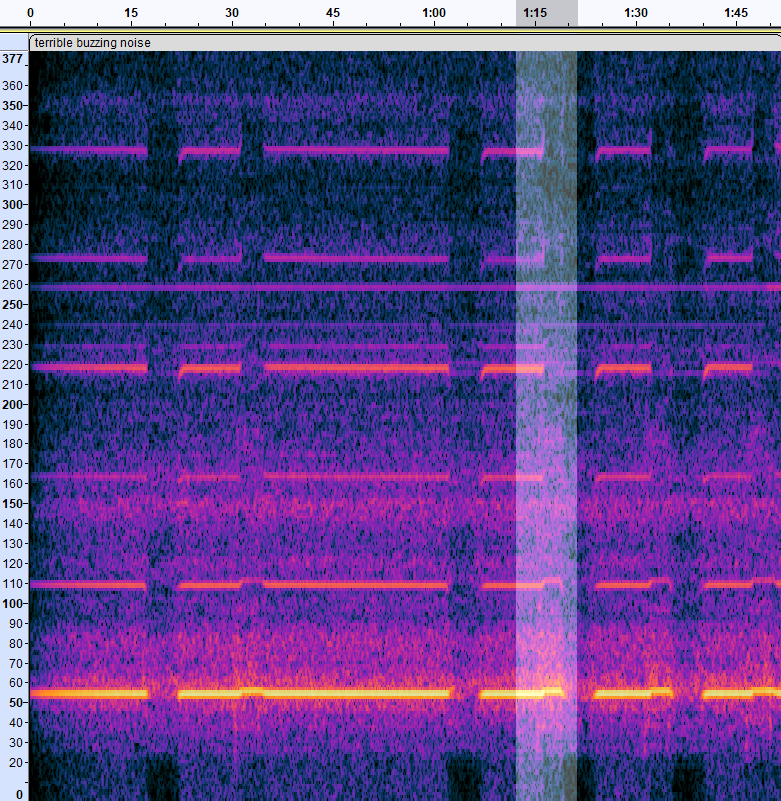
Here’s the problem – my neighbor’s HVAC closet is doing this, and it’s preventing me from sleeping:
Audacity spectrogram with primary component around 55 HzThis is the highlighted section
I’ve submitted a maintenance request, sure, but more data more better, right? There are three states here: not buzzing, buzzing, and buzzing without the higher component. 55 Hz primary, 220 Hz higher component. FFTs away!
I was hoping this would be the part where I link to the code, but boy howdy is it harder than I anticipated to get a microcontroller to do this.